


Pick up your camera manuals (or download and print it from the internet) and shout (use your inside voice) from the rooftops (figuratively), “I am in control of recording my family’s cherished memories. I am a believer. I am not your stepping stone. I will do my very best to take incredibly super duper groovy wicked awesome sweet radical photos of my loved ones and of strangers who hand me their cameras and ask nicely if I’ll take a photo of their family and/or friends while on vacation even if they are not wearing matching T-shirts identifying themselves as one cohesive group and not expect to be tipped even after pointing out the nearest restrooms and explaining what happened to Mickey’s Toontown Fair and the future expansion of Fantasyland.” You may now step down from the chair. Do not put the manual away, you’re gonna need it.
Point and shoot cameras are sophisticated creatures but they’re not nearly as difficult to operate as some might think. One of many features that originate from film cameras is exposure metering. Metering is how the camera determines what aperture, shutterspeed, and sometimes film speed to use based on available light. Chances are that your camera, along with my Canon PowerShot SX100 IS, offers 3 metering modes to choose from when shooting in Program (P), Aperture Priority (Av), Shutterspeed Prioity (Tv), and Manual (M).
Provided for you are samples, one of each type of metering mode, taken at Disney’s Animal Kingdom of a distant Expedition Everest because I am never getting on that thing. :clears throat: Sample photographs are of a lovely man made river, foliage, and a snowcapped mountain in the distant background.
 Evaluative measures the image by dividing it into sections and taking readings for an overall correct exposure. Evaluative metering can handle backlighting, shadows, multiple subjects, and other complex scenarious.
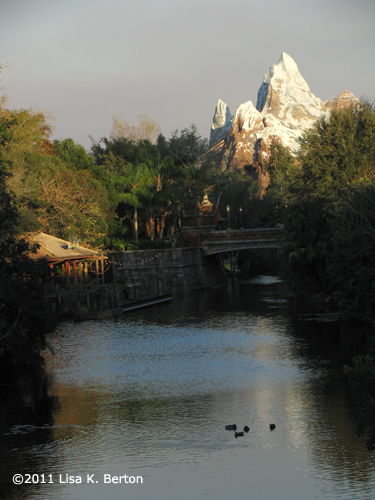
This photo has excellent exposure.* No detail is lost in Expedition Everest’s “snow” nor are the shadows too dark to see exactly what’s there. It’s very well balanced.
 Center weighted metering concentrates it’s reading off the middle of the image.
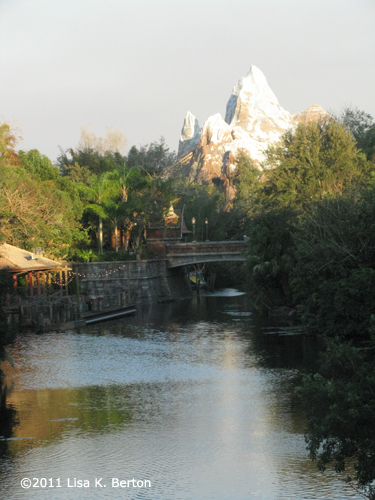
While the darker portions of the photograph have been lightened up significantly, the highlights are blown out and the sky is awash. In this case, center weightred metering was the wrong choice.
 Spot metering uses pre-selected points to read the image.
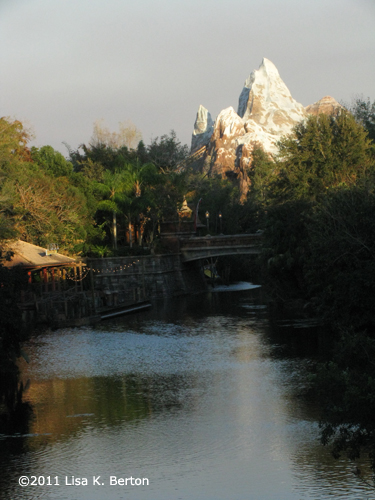
Compared to the two other pictures, this one is the middle child. Shadowed areas are just on the verge of being too dark, the sky isn’t washed out, and Expedition Everest kept most of it’s details.
The safest bet is evaluative metering but that doesn’t mean you shouldn’t try the other modes. Photography is all about trying new things, pushing yourself, and learning.
*Using evaluative metering does not guarantee ducks in your photographs.
Keep up with my freelance writing and photography via my Facebook page.






I think I can choose the part of the scene to meter on with Spot Metering on my camera, and then lock it in and recompose the scene to take the picture. But then, how would I know what part of the picture is best to frame for the Spot Metering? Or, maybe more on Center Weighted and Spot Metering were going to be your next blog postings, she says hopefully. Thanks!
Lisa responds: Where you meter depends upon the specific lighting conditions and what part of the image more important to you. If people are your subject, always goes off skin tones, specifically the face.