

When it comes to flying, many parts of the experience can be uncomfortable, including delays, long waits, and getting through security. However, there’s arguably nothing that could ruin a flight quicker than turbulence.
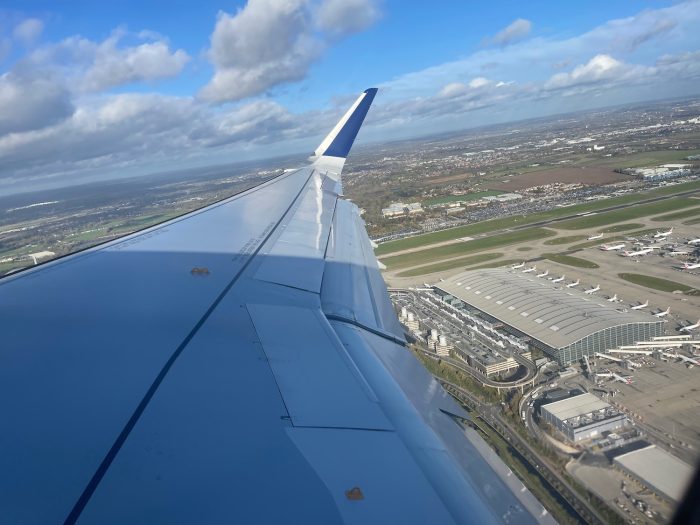
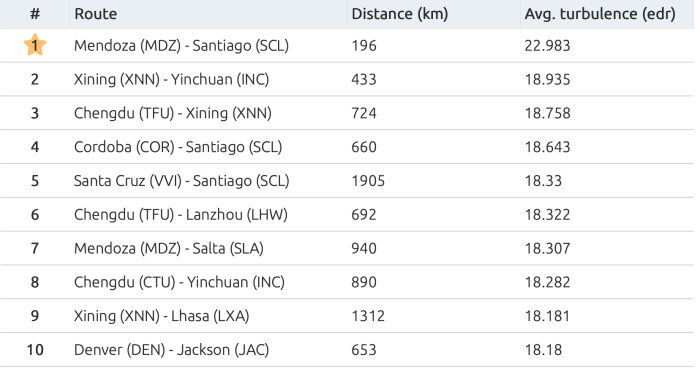
Recently, Turbli — a website dedicated to detailing and documenting turbulence — published its annual findings of the most turbulent flight routes in the world, including the 10 worst in the United States!

The website’s rankings are accumulated using turbulence forecast data from NOAA and the UK Met Office. As described by Turbli, “Every 6 hours, we save a snapshot of the most recent forecast covering the entire world over 18 pressure levels, and at the end of each month, we combine them to derive monthly and finally yearly statistics. In the rankings and forecasts, turbulence is given in units of eddy dissipation rate (edr), which is an aircraft-independent unit that represents the speed at which turbulent structures break down and dissipate their energy into heat. The boundaries between different turbulent levels vary between sources. At Turbli, we assume the following scale: 0-20 light, 20-40 moderate, 40-60 moderate-severe, 60-80 severe, 80-100 extreme.”
From there, the site examines airports and specific flight paths to create a list of 10,000 routes connecting the 550 largest airports in the world.

According to Turbli’s 2025 findings, the most turbulent route in the United States runs between Colorado’s Denver International Airport (DEN) and Wyoming’s Jackson Hole (JAC). The 653 journey has an edr of 18.18, which makes it not only the most turbulent in North America, but the 10th most turbulent route in the world according to Turbli.
The North American Top 10 is rounded out by Albuquerque (ABQ) to Denver (DEN), Jackson Hole (JAC) to Salt Lake City (SLC), Denver (DEN) to Salt Lake City (SLC), Bozeman (BZN) to Denver (DEN), Boise (BOI) to Bozeman (BZN), Bozeman (BZN) to Salt Lake City (SLC), Albuquerque (ABQ) to Salt Lake City (SLC), Denver (DEN) to Las Vegas and Las Vegas (LAS) to Salt Lake City (SLC).
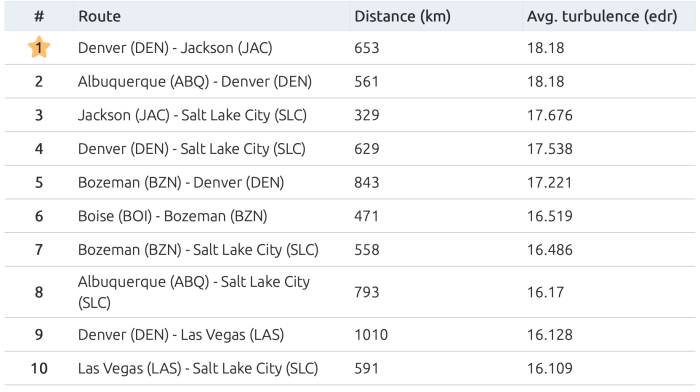
What we’re taking from that is that pretty much anyone flying around Salt Lake City, Utah, Bozeman, Montana, or Denver, Colorado may want to pack a few extra air sickness bags.
If you’re planning on flying domestically anytime soon, you may want to check Turbli to see just how much turbulence you can expect to endure on your flight! Stay tuned to AllEars for more on aviation and the travel industry.
8 Popular Travel Items That Could Raise Red Flags at TSA
Have you ever run into severe turbulence on a flight? Let us know in the comments below.












Trending Now
Amazon has 35 brand new Disney Loungefly Mini Backpacks!
We'd love to see these tweaks come to Disney's refillable mugs!
This Disney World hotel trap is one to watch out for and this might be...
We've compiled a list of some of the best items you should pack for your...
We're breaking down all the big changes coming to Disney World next month!
Grab these Disney Parks essentials on Amazon Haul for super affordable costs!
Disney is changing senior leadership again!
Disney brought back a once-popular ticket option... but is it worth it?
We just got to ride the NEW Soarin' Across America and have so much to...
If you’ve been trying to find a water bottle that survives rope drop through fireworks,...
With the opening of Rock 'n' Roller Coaster Starring The Muppets just a few weeks...
The Diamond Horseshoe is closed for the summer!
Let's talk about some of the downsides to staying at Disney's Port Orleans Hotel.
A popular restaurant is closing SOON at the Orlando International Airport.
BoxLunch is having a big Disney sale right now!
There's a new show coming to Disney's Hollywood Studios, and we just got a big...
The opening date for a NEW "Time Traveling" theme park expansion has been announced!
From Marvel tees to Super Mario shirts, these retro shirts are worth checking out on...
We've never seen this in Disney World before, but now we need one in each...
We are rounding up 26 Disney Loungeflys that are perfect for your 2026 Disney World...