

As marriage proposals go, this one was a doozy.
Roy O. Disney popped the question to his bride-to-be, Edna Francis, by sending her – wait for it – a telegram!
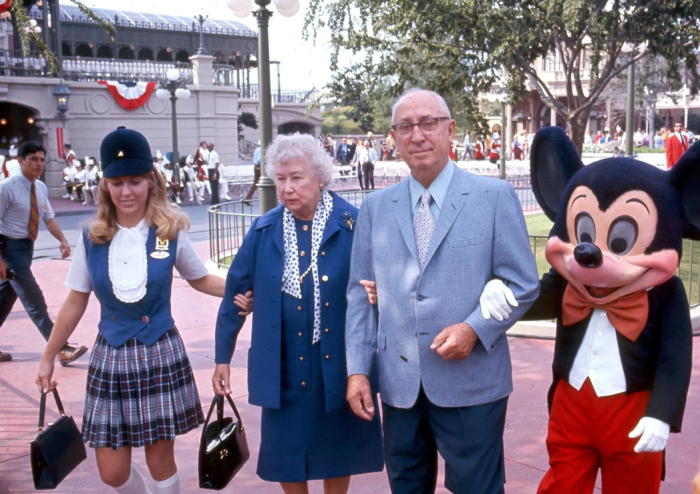
Of course, the circumstances were a bit unusual. You see, Roy – Walt Disney’s older brother – was in California recuperating from tuberculosis. Edna was back home in Missouri. They had been dating for several years and even talked about possibly getting married.
In the spring of 1924, Roy “sent me a telegram,” Edna said. It read: “Gosh … about time we got married.”
“That’s a funny way to do it,” Edna admitted, “but it worked out fine.”
Roy and Edna, who met while working in the same office together, talked about getting married … until World War I intervened.
Roy was honorably discharged from the Navy near the end of World War I when he was diagnosed with tuberculosis. He spent the next several years recovering at military hospitals in New Mexico, Arizona, and California.
As Roy recuperated in California, Edna and her family looked after Roy’s brother Walt, who was struggling with his first animation studio, Laugh-O-Gram Films, in Kansas City.
Edna recalled that “Walt used to come out to our house. He was having kind of a struggle financially and when he’d get hungry, he’d come over. We’d feed him a good meal and he’d talk until almost midnight, about cartoon pictures mostly, and things he wanted to do.”
Walt even hit up Edna for a loan when he was struggling, sending her a letter asking for financial assistance.
“Don’t tell Roy I wrote, but we need money. Can you send us some, and if so, how much?” Edna did, no questions asked.
After Walt moved to Hollywood in 1923 to start the Disney Brothers Studio, Roy left the hospital to join his brother’s “latest and greatest dream.” That’s when Roy sent his marriage proposal to Edna. They were married a year later at the home of his uncle, Robert Disney, on Kingswell Avenue.
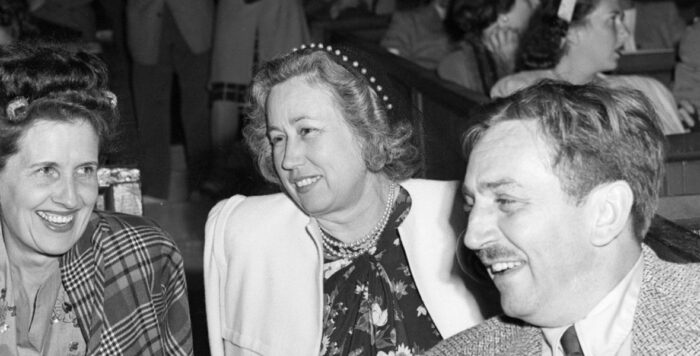
After moving to California with her mother, Edna frequently assisted with office work at the fledgling studio, and, along with Walt’s future wife, Lillian Bounds, helped ink and paint animation cels when needed.
It was during this time that Disney lost the rights to the Oswald the Rabbit character. In addition, Walt learned that many of his key artists would be jumping ship to join Winkler-Mintz Productions. Out of desperation, he came up with the idea for a new cartoon series, this one featuring a mouse.
His most trusted animator, Ub Iwerks, did all of the animation for would-be aviators Mickey and Minnie Mouse for a film titled Plane Crazy. And it was all done in secrecy.
“The deserting men didn’t know that Walt knew they were going to leave,” Iwerks said. “I worked in a locked room.” The sequestered Iwerks produced, on average, 700 drawings a day, reaching more than 8,000 separate drawings for the film.
The next problem was finding inkers and opaquers to complete the animation process.
Walt set up a makeshift studio in his garage with three benches, where Lillian and Edna Disney and Kathleen Dollard Smith (the studio’s first employee) did all of the tracing and opaquing of the cels. It was tedious work, to be sure.
“Even when we were sitting at the kitchen table, we used to just paint those cels,” Edna recalled. “It was when they were starting Mickey Mouse” and they were trying to keep it secret. “I just tried to do the best I could.”
Once Plane Crazy was completed, Iwerks began work on the next animated short featuring Mickey, The Gallopin’ Gaucho.
At this point in time, the first “talking film,” The Jazz Singer, had been released. The motion picture world would change forever.
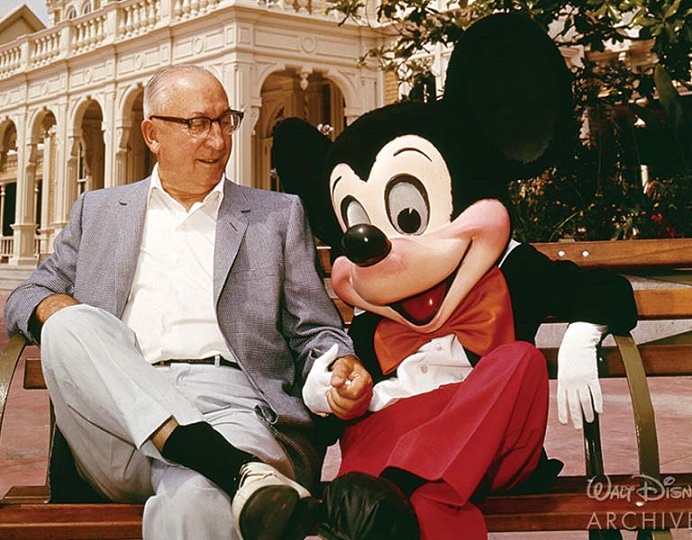
“It occurred to me … that a cartoon with action synchronized to sound would be something of a sensation,” Walt said. “My third Mickey, Steamboat Willie, was planned with this in mind.”
After many fits and starts, Steamboat Willie – the first animated short with sound – premiered to rousing acclaim on Nov. 18, 1928.
As the Disney Brothers Studios began to enjoy a measure of success, the two brothers and their wives bought adjoining lots on the corner of Lyric Avenue and St. George Street in Los Angeles, just a few blocks from their Hyperion studio. They built houses next to one another on those lots and often entertained family and friends there.
Thanks in part to his experience working at a bank, Roy was considered the “financial genius” of the company. Indeed, whenever Walt came up with an idea for a new project, it was Roy who had to find the money to pay for it.
Indeed, when Walt decided to go ahead with plans to build Disneyland in the early 1950s, he sent Roy, armed with sketches of the park by Disney Legend Herb Ryman, to New York to seek out investors. And when Walt Disney World was in its planning stages in the late 1960s, Roy and Disney legal counsel Bob Foster – using pseudonyms – went to central Florida to scoop up as much land as cheaply as possible.
With Edna’s inking and painting days behind her, she took on the role of Roy’s trusted confidant. But she was much more than that.
Roy E. Disney, Roy O. and Edna’s only child, recalled that “Mother was a true partner with my father. She traveled with him around the world to visit colleagues. When they came to Burbank, she’d cook them a chicken dinner at our home. After serving in her kitchen, she usually encouraged them to help wash the dishes after eating.”
Edna Disney was one of the members of the Disney family who neither sought nor received much attention. But like her equally low-key husband, she played an important role in the company’s development.
“She was good friends with many Disney employees; she had a unique gift for understanding people,” her son said.
Disney Legend Bill (Sully) Sullivan enjoyed a special relationship with Roy and Edna.
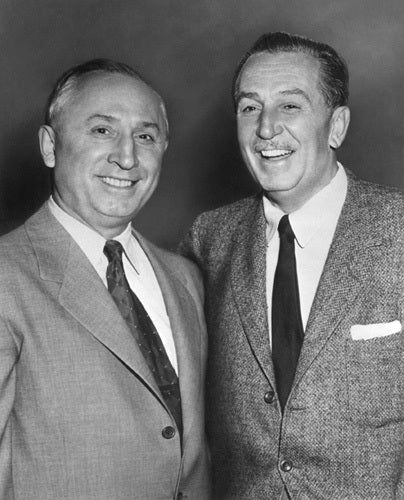
“I’ll never forget one Sunday morning I was on duty in Disneyland,” Sully said. “I was on Main Street and Roy and Edna walked out of the door of the firehouse. I went over and said, ‘Good morning.’ And Roy said: ‘Meet me at the back of the Hills Brothers Coffee Shop so we can get some coffee and a Danish.’
“I did just that and Roy asked me to join him and his wife for breakfast. Nice, nice man. We started talking about the plans for EPCOT and Walt Disney World.”
When the company’s interests shifted to Florida and Walt Disney World, Sully was reassigned — by none other than Roy O. Disney himself — to the project.
“We need experience down there,” Roy told Sully.
Another one of those special Roy-Edna friendships was with Tania Norris, a former member of WED Enterprises, the forerunner of Walt Disney Imagineering.
Indeed, during her tenure at WED, Tania struck up warm relationships with both Roy and Edna, as well as Lillian Disney and her daughters Sharon and Diane.
“Roy was very sweet,” Tania said. “I used to see Roy and Edna having coffee in Wilshire every Saturday morning. They were just very lovely, genuine people.”
Tania’s love of antiques helped cement her relationships with Edna and the rest of Disney’s “leading ladies.”
“I used to take Edna antique shopping, as I did Lilly and Diane and Sharon. Lilly was always so sweet, too.”
Edna also was known for her sense of humor … which came as a shock to many Disney executives.
“I remember one occasion when Dick Irvine, who was the head of WED at that time, and Admiral Joe Fowler called me to the office and they said, ‘Would you mind taking Edna shopping?’” Tania said. “And I said ‘Not at all. She has a wonderful sense of humor.’
“I remember them looking at each other and saying, ‘She does?’ I obviously knew her as a person more than they did. She was very low-key, as was Roy.”
In the aftermath of probably the darkest day in Disney history, Roy turned to Tania Norris after his brother died on Dec. 5, 1966. A few days after Walt’s death, with the company still in a state of shock, Roy Disney gathered some of the company’s top executives to discuss the future.
“After Walt died, Roy called together the heads of all the departments to come to the Studio, to tell them that EPCOT would continue and things would go on. I was invited to attend and I was the only woman there,” Tania said.
“I found that very odd, because I really didn’t have that high a position, but I did know Roy. Whether that was a factor, I really didn’t know, but I felt that was quite an honor to be included in that group.”
Roy postponed his retirement to see Walt Disney’s dream of bringing the Walt Disney World project to completion.
But that meant burning the candle at both ends for a man who was in his late 70s.
“I don ‘t know where he got all of his energy,” said long-time Disney cast member Bill Hoelscher, who started his career at Disneyland, worked at the 1964-1965 New York World’s Fair and ran the WDW Preview Center.
“He was always running from one project to another. But he was always a real gentleman.”
“I remember looking at Roy Disney on opening day (at Walt Disney World) … the sparkle in his eye and the smile on his face,” recalled Debby Dane Browne, who was part of Disney’s Preview Center staff and who would become Walt Disney World’s first ambassador.
“You could sense the pride he felt. He was so happy to see Walt’s dream become a reality.”
It was Roy who insisted on changing the name from Disney World to Walt Disney World, making sure his brother’s name would live in perpetuity.
“When Walt died, Roy really took over,” Disney Legend Marty Sklar said. “Roy literally gave his life to make sure Walt Disney World was finished. He died two months after it opened” in December of 1971.
Like his wife, Roy O. Disney never sought the spotlight. And while Roy and Edna spent their lives in the shadow of the incomparable Walt Disney, the two still made significant contributions to the success of the Walt Disney Company.
And it all started with a telegram.
(A nod of appreciation to Mindy Johnson, the author of “Ink and Paint, The Women of Walt Disney’s Animation,” for supplying some of the material used in this blog).
Chuck Schmidt is an award-winning journalist and retired Disney cast member who has covered all things Disney since 1984 in both print and on-line. He has authored or co-authored eight books on Disney, including his On the Disney Beat and The Beat Goes On, as well as his latest, Marty, Mickey and Me, all for Theme Park Press. He has written a regular blog for AllEars.Net, called Still Goofy About Disney, since 2015.









Trending Now
The France Pavilion has officially crossed the line from "popular" to "perpetually packed," and if...
Whether you're a ride warrior, a resort-hopper, or someone who spends three hours grazing through...
These Disneyland and Disney California Adventure rides won't be available to guests in June.
This iconic horror franchise once had a home in Universal Orlando.
Which is better: Universal's Express Pass or Disney World's Lightning Lane? Our readers share their...
Southwest Airlines has ANOTHER seating policy change.
These Loungefly bags will give you serious nostalgia.
A new Disney+ subscriber perk could take you straight to Disney World!
We've got a new batch of finds from ALDI!
This is episode 4 of The Disney World Hotels Disney Doesn't Want You to Know...
Six new flights are coming to Central Florida following Spirit Airline's closure.
We just got several new photos that reveal a construction update for the NEW Tropical...
From stained glass portraiture to iridescent cake aesthetics, there's something genuinely new and exciting happening...
These are the best shoes to wear to Disney World and beyond!
Something is changing in Toy Story Land!
We LOVE Epic Universe, but after a year of real-world park days, two problems are...
Brand-new Starbucks Blue Coconut Refresher and Blue Coconut Matcha are coming soon!
Disney's most anticipated LEGO set has FINALLY dropped online!
We're about to challenge some longstanding EPCOT traditions, but trust us, it's worth it!
New McDonald's Happy Meal toys are coming for the 2026 FIFA World Cup!