

For decades, Walt Disney World has elevated the Christmas season into the most wonderful time of the year. Similarly, Christmas movies produced for the Hallmark Channel have taken the holidays to new levels of cheer.
But what about a Hallmark Christmas movie set in Walt Disney World? My only thought is: What took so long?
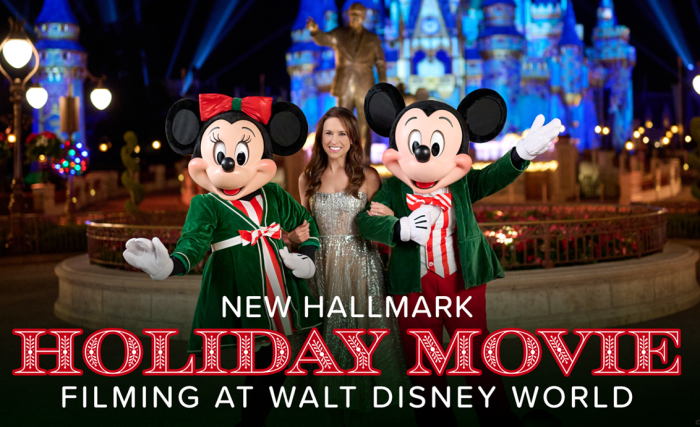
News that Hallmark was in Walt Disney World recently, filming an all-new, original Christmas movie called Holiday Ever After: A Disney World Wish Come True shouldn’t come as much of a surprise.
Hallmark is known for its wholesome, family-friendly products and services, which are very much in keeping with Disney’s mission statement.
Over the years, the Christmas movies shown on the Hallmark Channel have become an integral part of the holiday season for many, many people. Most folks will tell you that the movies follow a predicable storyline, but in the end, everyone lives happily ever after. The movies are heartwarming and almost always end with a message of hope for the future.
A Disney-Hallmark collaboration is nothing new.
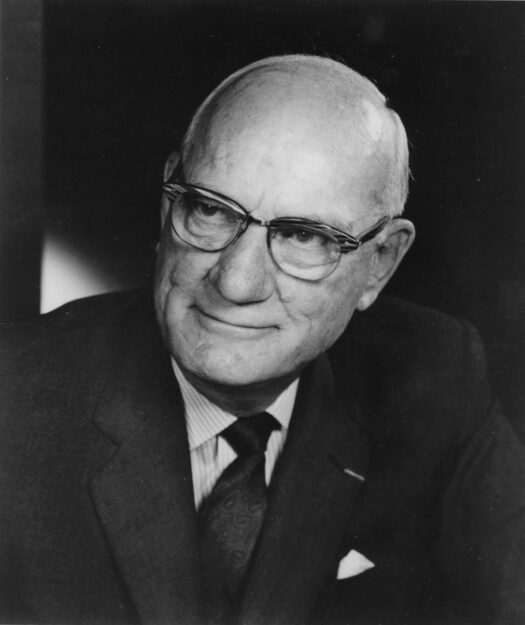
“The partnership between Hallmark and Disney dates back decades, when a shared Kansas City connection and friendship between Hallmark’s founder, J.C. Hall, and Walt Disney himself led to our first-ever licensed products, including the very first greeting card featuring Mickey Mouse,” said Darren Abbott, Chief Brand Officer for Hallmark.
“We’re thrilled to expand our relationship beyond the products we create together and onto the screen with this heartwarming and joyful Christmas movie that embodies the very best of both brands.”
Holiday Ever After: A Disney World Wish Come True will debut in the fall during Hallmark Channel’s 17th annual Countdown to Christmas series. It will star Lacey Chabert, Travis Van Winkle, Richard Kind, Christy Carlson Romano, Bryce Dufee, Taegen Burns and Asher Alexander.
“Storytelling is at the heart of both Disney and Hallmark, and that magic shines even brighter during the holidays,” said Sally Conner, Disney’s vice president for Global Content. “We’re thrilled that Walt Disney World will serve as the immersive setting for a Hallmark holiday movie highlighting the cheerful festivities of the season.

“Across our theme parks, resorts, and beyond, countless unique stories unfold and new memories are made every day with our guests. This film is a wonderful way to share that joy and pixie dust with fans everywhere.”
The Hallmark-Disney connection goes deeper than a holiday movie or Disney-themed greeting cards.
It goes all the way back to the 1960s, when Walt Disney was crystalizing plans to create an experimental prototype community of tomorrow … or EPCOT.
Walt, fresh off his company’s triumph at the 1964-1965 New York World’s Fair and still riding high after Disneyland’s decade-long success, wanted to tackle what he considered America’s greatest problem: Urban decay.
His solution? Create a city of the future … a Utopian mecca where residents could live, work and recreate in an environment free of urban blight, noise and vehicular congestion. He didn’t just want to remake existing cities. He wanted to start from the ground up on virgin land.
That was EPCOT’s true intent … its mission statement, if you will.
At the time, Walt Disney was part of a small, influential group of dreamers who sought to change the way urban planners were designing cities.

One of those dreamers was developer James W. Rouse, who, after visiting Disneyland, came away awestruck. In his keynote speech to the Urban Design Conference at Harvard University in 1963, Rouse said:
“The greatest piece of urban design in the United States today is Disneyland. I find more to learn in the standards that have been set and in the goals that have been achieved in the development of Disneyland than in any other place of physical development in the country.”
Rouse would go on to put many of his own theories on urban planning into practice with the development of Cross Keys in Baltimore, Maryland. He added that his desire to develop Cross Keys was “to create a community which can meet as many as possible the needs of the people who live there.”
Cross Keys became a mix of townhouses, garden apartments, high-rise apartment buildings, stores grouped around a village square and an office complex. And it was well received.

Another one of those dreamers was J.C. Hall, who was dissatisfied with the direction of America’s cities and dared to think urban design could be altered to make living within a city efficient and enjoyable.
Hall’s concept evolved into something called Crown Center, a privately financed city-within-a-city developed adjacent to Hallmark’s international headquarters in Kansas City, Missouri.
“I just don’t like to sit around and wait for something to happen,” Hall said. “It’s more fun to make it happen.”
From his office in Hallmark’s headquarters, Hall could see how decayed the land nearby had become. There were rutted parking lots, abandoned warehouses, the sorry remains of failed or failing businesses, and a limestone hill cluttered with signs and tarpaper shacks.
Hall and his son Donald believed Hallmark, the industry leader in personal expression, deserved a better setting for its home base – and that the city which had given so much to them deserved better. They had two choices: Follow the stream of businesses fleeing the city for the suburbs; or stay and make the city environment better. They chose to stay.
Crown Center combines living accommodations, office buildings, hotels and an entertainment district within 85 acres. It was deemed a “city within a city” and it, too, has been a huge success.
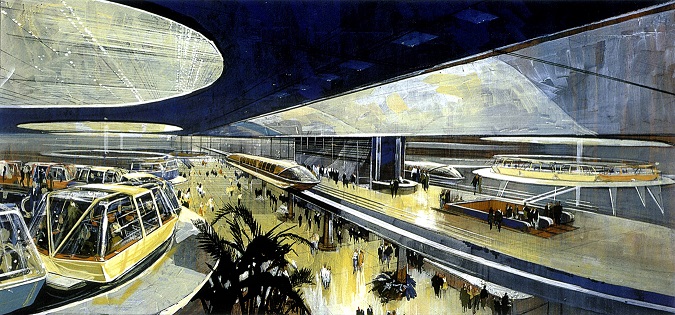
EPCOT never lived up to Walt Disney’s plans for a city of the future, in large part because he passed away before his dreams could be realized. Walt was so enamored of the EPCOT idea that he was prepared to hand off the company’s day-to-day operations in order to focus solely on the project’s development.
Still, the entire Walt Disney World complex does mirror a city in many important ways.
Disney Legend Marty Sklar once told me that Walt Disney World – all 43 square miles of it – takes on all the characteristics of a fully functioning city.
“People who visit Walt Disney World need to be housed, they need to be fed, and they need to be transported around the property,” he said.
And, like Cross Keys and Crown Center, Walt Disney World offers its guests a wide range of entertainment options.
And so, a Hallmark Christmas movie that takes place in Walt Disney World? Talk about a full-circle moment.
Chuck Schmidt is an award-winning journalist and retired Disney cast member who has covered all things Disney since 1984 in both print and on-line. He has authored or co-authored eight books on Disney, including his On the Disney Beat and The Beat Goes On, as well as his latest, Marty, Mickey and Me, all for Theme Park Press. He has written a regular blog for AllEars.Net, called Still Goofy About Disney, since 2015.













Wow! This article was not what I expected! I thought it would just be announcing a film project (which is exciting enough in itself) but this was a really interesting historical feast. Chuck’s articles are always excellent. More like this please!