

Climbing the company ladder can be tough, especially when you start out on the bottom rung.
That being said, it’s mind boggling how so many prominent Disney executives started their careers at jobs that many folks would consider menial.
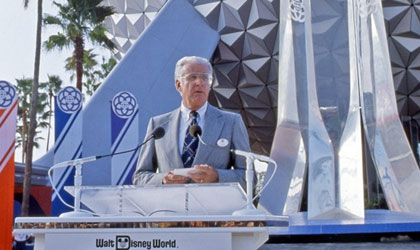
E. Cardon (Card) Walker is a prime example. Card, as he was known, was president, chairman and Chief Executive Officer of the Walt Disney Company from 1971 to 1983. It was under his stewardship that the Experimental Prototype Community of Tomorrow – or EPCOT – and Tokyo Disneyland became a reality.
Where did Card begin his career? In the mailroom at the Walt Disney Studios in 1938.
After serving honorably in the United States Navy during World War II, Card returned to Disney, where he worked in the camera and story departments. He quickly rose through the ranks, first as vice president of advertising, then as vice president of marketing, followed by his appointment as executive vice president and chief operating officer.
When Roy O. Disney died in 1971, Card assumed the role of company CEO. His career went from the lowly mailroom to head of the boardroom.
Card Walker also was instrumental in hiring one of the most important members of Disney’s creative staff.
Back in early 1955, Walt Disney thought it would be a great idea to put together a turn-of-the-20th century newspaper, to be sold at his soon-to-be-opened Disneyland park. Walker, then VP of marketing, was tasked with finding the right person for the job.
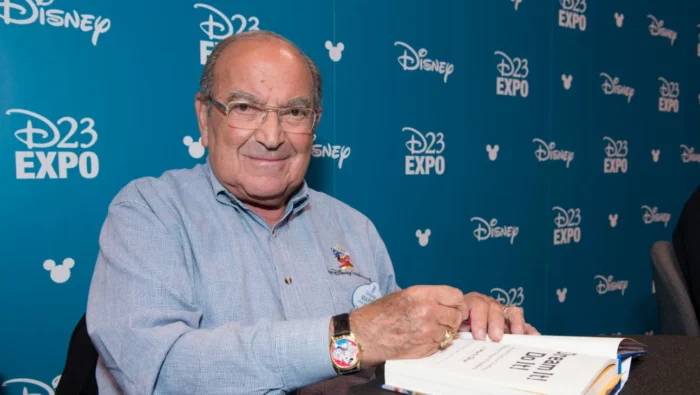
At the time, Marty Sklar was a college student heading into his senior year at UCLA and was about to become editor of the university’s campus newspaper, The Daily Bruin.
A man named Johnny Jackson, who was executive director of the UCLA Alumni Association and who just started working for Disney, reported to Card Walker. It was Jackson who recommended Marty for the editor’s job on what would become The Disneyland News.
Walker tracked down Marty and offered him the position. The paper was a big success and, after Marty went back to school and earned his degree, he returned to work in Disneyland’s public relations department. From there, Marty’s Disney career took off.
He became Walt Disney’s personal wordsmith, writing speeches and reports for the boss. Marty went on to work for WED Enterprises, the forerunner of Walt Disney Imagineering, where he left an indelible mark.
Marty rose through the ranks to become president of Imagineering, where he spearheaded a number of important projects which launched Disney into the 21st century.
He was named a Disney Legend in 2001. He has a window in his honor on City Hall in Disneyland, as well as windows along the Main Streets in Walt Disney World and Disneyland Paris.
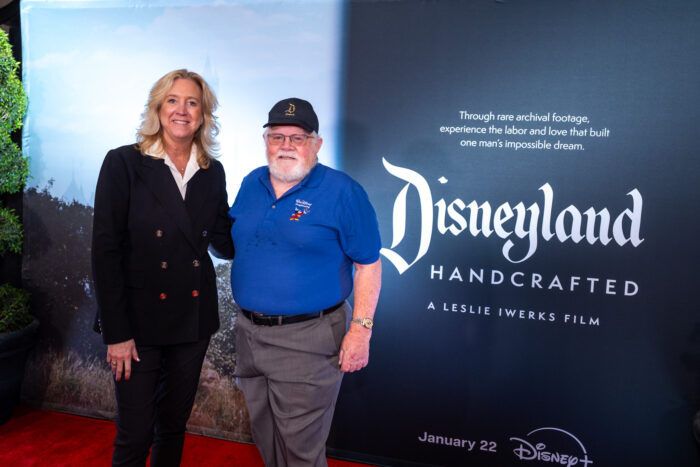
In an interesting twist, The Disneyland News also played an important role in launching the career of an energetic young man named Tom Nabbe, who was on the outside looking in when Disneyland opened in July of 1955.
Tom grew up in Los Angeles, where he had a successful paper route. When the Nabbe family moved to the sleepy suburb of Anaheim, Tom managed to secure a part-time newspaper delivery gig, hawking the Sunday paper to workers exiting the Disneyland construction site.
It was during his Sunday morning trips to the site that he got to know two brothers who had a hand in changing the course of his life: Ray and Joe Amendt. The Amendts ran a concession stand inside Disneyland called Castle News when the park opened on July 17, 1955.
In addition to stroller and wheelchair rentals, Castle News distributed The Disneyland News, the early 1900s-themed newspaper conceived by Marty Sklar. “The deal was that I would get 100 papers to sell outside the park, and once I did that, I’d be allowed into the park to sell more papers,” Tom said.
Once inside the park, Tom got to know several Disney executives, including Walt Disney. And when Tom heard those execs talking about a proposed new attraction called Tom Sawyer Island, he campaigned to play the role of Tom Sawyer. Once Walt Disney was on board with the idea, Tom landed the part … and his career took off.
Tom became Tom Sawyer Island’s goodwill ambassador, posing in character for photos with guests and assisting them with their fishing equipment (yes, back in the day, you could fish from Tom Sawyer Island).
When he outgrew the part, Tom became a ride supervisor in the park. And when the call went out for cast members to relocate to Walt Disney World in the early 1970s, Tom and his bride Janice relocated to central Florida.
Tom was the opening day supervisor for the WDW monorail. He finished his Legendary career working backstage in logistics.
He has a window honoring his accomplishments along Main Street in Walt Disney World.
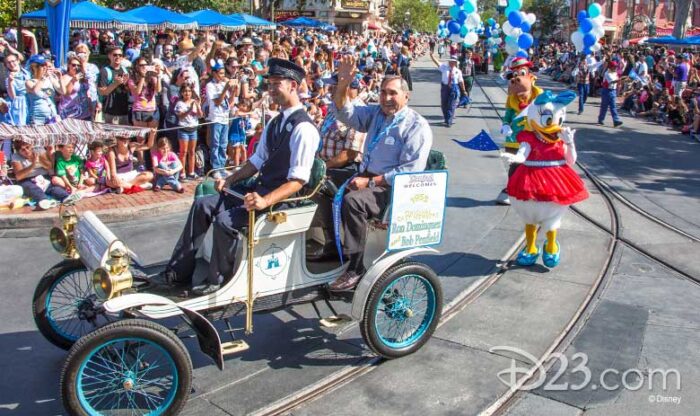
Ron Dominguez was another Disney Legend who began his career at the bottom. When Disneyland opened, he worked in one of the park’s ticket booths. At the time, Ron expected he would work at Disneyland during the summer, then return to Arizona University.
Working at Disneyland was a homecoming for Ron … mainly because his family had owned a large swath of orange groves which Disney needed to purchase to build its park.
In fact, the home which Ron Dominguez grew up in was located about where Pirates of the Caribbean and Haunted Mansion now reside. A man named Doc Lemmon was responsible for getting the Dominguez family to sell their 10 acres to Disney and it was Doc Lemmon who convinced Ron to pursue a career with Disney.
“I was ready to go back to school in 1955 when Doc said to me, ‘Why don’t you stay around? This place is gonna be successful.’ I talked to my parents about it … thank God I took the chance!”
Ron, just 19 at the time, was on duty on opening day, July 17, 1955, and remembered the utter chaos from dawn ’til dusk.
When the invitations went out to dignitaries and members of the press, Ron recalled, “The idea was to stagger the times of entry, to spread out the crowds so there wouldn’t be a mad rush.
“That didn’t work very well because everybody wanted to be the first one in. It was a really hot day … and we became the kings of crowd control. It was a madhouse, no question.”
Ron went on to hold a number of supervisory positions in Adventureland, Frontierland and Tomorrowland before taking on more managerial responsibilities.
By 1970, Ron was appointed Disneyland’s director of operations, and, four years later, he was named vice president of Disneyland and chairman of the park operating committee. In 1990, he was promoted to executive vice president, Walt Disney Attractions, West Coast.
After 39 years of service, Ron retired in August of 1994. He was named a Disney Legend in 2000.
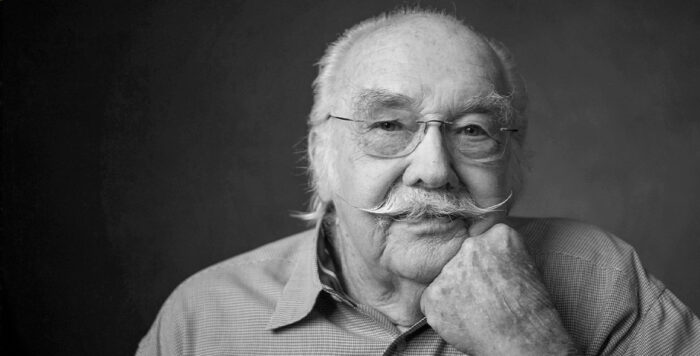
Bill (Sully) Sullivan was fresh out of high school when he watched in amazement as the press preview day at Disneyland unfolded on ABC-TV on July 17, 1955.
At that moment, Sully caught Disney fever. The following Saturday, he applied for a job at Disneyland. On Monday, he quit his job at Northrop Aircraft and on Tuesday, he reported for work as a ticket-taker for the Jungle Cruise attraction at Disneyland. Back in those days, you bought a general admission ticket to get into the park, then used separate tickets to gain admission to each attraction.
Sully’s Jungle Cruise gig was the beginning of a 40-year career that saw him tackle a boatload of assignments both in Disney theme parks and outside the parks at Disney-related events, such as ceremonies involving the 1960 Winter Olympics, overseeing the premiere of the movie Mary Poppins and the 1964-1965 New York World’s Fair.
“I was in the right place at the right time,” he said. “Folks had faith in me. I had never been in a place with the magnitude of the Contemporary Resort, let alone work in it. I just had a tremendous experience throughout my career. I got to go to New York, Paris and Tokyo. The company supported me and gave me the opportunity.”
Sully retired in 1993 and was named a Disney Legend in 2005.
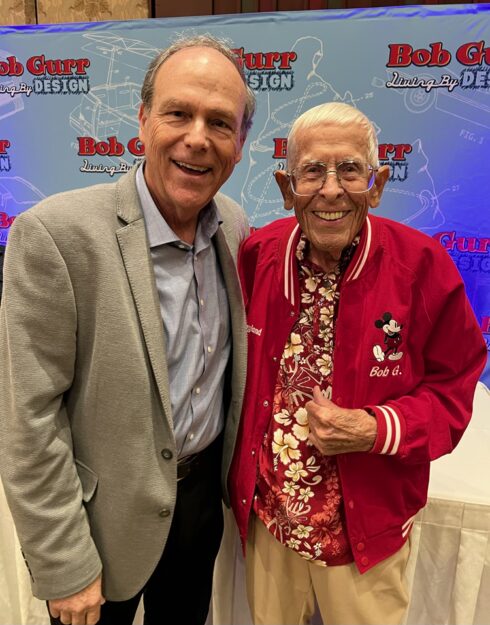
Bob Gurr was an automobile stylist when he was hired by Disney several months before Disneyland opened to work on the Autopia miniature cars attraction.
“Walt assumed that if I did the body of a car, that I also was mechanical, which I wasn’t,” Gurr said. “I just kept my mouth shut and kept learning.”
The Autopia cars were a big hit during Disneyland’s opening … until the heat of the day reduced the fleet to a handful of working vehicles. Still, Gurr’s contributions didn’t go unnoticed.
The car stylist “kept learning” as he was assigned to even more complex and revolutionary park attractions. In 1959, a submarine voyage, a monorail system and the Matterhorn Mountain bobsleds all debuted at Disneyland – all with Gurr’s skilled input.
A few years later, Gurr the car stylist was given perhaps his greatest challenge: Help in giving lifeless forms, life-like movements.
The advent of Audio-Animatronics may have been Gurr’s greatest achievement. He was tasked with designing the inner workings of the Abraham Lincoln figure for the Illinois state pavilion at the 1964-1965 New York World’s Fair.
In doing so, he created an innovative system to manufacture parts that could be used on any number of Audio-Animatronics figures, be they human, animal or prehistoric.
Disney’s four shows at the World’s Fair were big hits and all four featured Audio-Animatronics figures in some shape or form.
And all this from a hot-shot car stylist. Gurr was named a Disney Legend in 2004.
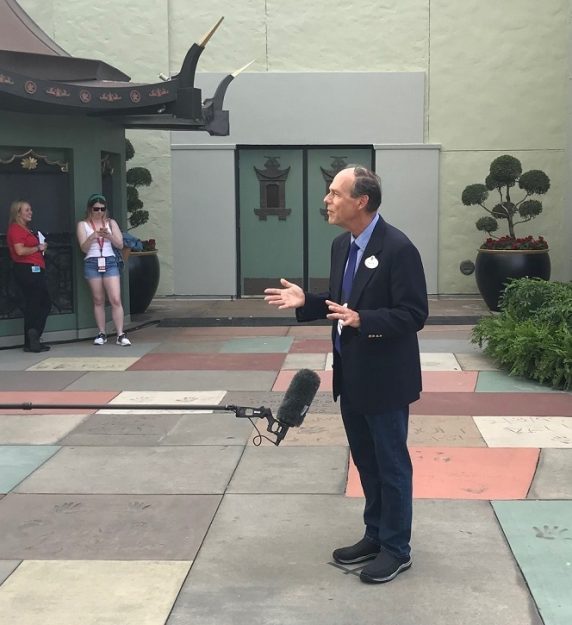
Retired Walt Disney Imagineering Creative Director Kevin Rafferty took a long and winding road before hitting his stride, career-wise.
You see, there’s probably no lower rung on the corporate ladder than restaurant dish washer.
When Kevin was fresh out of college with an art degree in hand, he applied for a job at Disney, with dreams of artistic grandeur dancing through his head. Walt Disney Animation, he thought, here I come!
Rafferty did land a job with Disney … but as a dish machine operator (DMO) in the Plaza Inn Restaurant at Disneyland. As his dad told him: “The only time you’re going to find success before work is in the dictionary.”
After months of blood, sweat and a few tears as a DMO, Kevin received a promotion: He was elevated to busboy at the exclusive Club 33. From busboy, Kevin slowly climbed up the Club 33 ranks, first as a maître d’, then sous-chef, waiter, bartender, and finally lead.
After his tuxedoed time at Club 33, Kevin moved closer to his dream job when he was hired by WED Enterprises, the forerunner of Walt Disney Imagineering, which was in the planning stages of building EPCOT. His job? Sweep floors, clean tables, empty trash cans and serve as a “go-fer” for some of Disney’s most talented artists.
And to do that, he had to take a pay cut … and drive 100 miles roundtrip each day to WED’s Glendale offices. And to add insult to injury, after the work of EPCOT was completed, he was let go.
Needless to say, Kevin’s story had a happy ending. He was rehired by WED and found his way into the creative wing of the company, where his wildly imaginative ideas took root and flourished, churning out one popular attraction after another.
During his storied career, Kevin had a hand in developing some of the most iconic and popular Disney parks attractions ever created, including Toy Story Midway Mania!, Radiator Springs Racers, Twilight Zone Tower of Terror, It’s Tough to be a Bug!, Rock ‘N Roller Coaster, and Mickey and Minnie’s Runaway Railway.
Chuck Schmidt is an award-winning journalist and retired Disney cast member who has covered all things Disney since 1984 in both print and on-line. He has authored or co-authored eight books on Disney, including his On the Disney Beat and The Beat Goes On, as well as his latest, Marty, Mickey and Me, all for Theme Park Press. He has written a regular blog for AllEars.Net, called Still Goofy About Disney, since 2015.








Great article, as usual, Chuck.