|
ANIMAL
KINGDOM
TOURING
Attraction
Seating
Photo Gallery
Basic Services
Calendar of Events
Character Meet and
Greet FAQ
Extra Magic Hour
FASTPASS
Fun Facts
Guide Map
Kennels
Operating
Hours
Overlooked Attractions
Reader Tips
Rehabs and Closures
Restaurant Photo Gallery
Ride Restrictions
Smoking Policy
Special Needs Travelers
--Animal
Kingdom
in a Wheelchair
Ticket FAQ
WDW At Large
AT
A GLANCE...
Animal
Species by Area
Attractions
Restaurants
Characters
Shopping
THE
OASIS
Place of Transition Part I
Place of Transition Part II
DISCOVERY
ISLAND
The Tree of Life
It's Tough to be a Bug
Discovery Island Trails
CAMP
MINNIE-MICKEY
Festival of the Lion King
Character Greeting
Trails
Pocahontas and Her
Forest Friends - Ends 9/27/08
AFRICA
Kilimanjaro
Safaris
Pangani Forest
Exploration Trail
RAFIKI'S
PLANET WATCH
ASIA
Expedition
EVEREST
Flights of Wonder
Kali River Rapids
Maharajah Jungle Trek
DINOLAND
U.S.A.
Dinosaur
The Boneyard
Dino-Sue
Chester and Hester's
Dino-Rama
--Primeval Whirl
--Triceratop Spin
Finding Nemo: The Musical
ENTERTAINMENT
Mickey's
Jammin'
Jungle Parade
Mickey's JINGLE Jungle Parade
DiVine
Live
Entertainment
Special
Reports
African
Comb Duck
Asian Tigers
Baby African Elephants
Capybara
Giraffe
Nile Hippopotamus
Okapi
Photo
Essays
Gorillas
Faces
Hidden Mickeys
Park Details
ALL
EARS®
Feature Articles
-- Animal Kingdom Turns 10
--
Animal Kingdom Turns 5
-- Kaleidoscopic Kingdoms
--
Other Side of Animal Kingdom
TOURS
--
Back Stage Safari
-- Wild by Design
ARCHIVES
Tarzan
Rocks! Closed
1/06
Journey
into the Jungle Book
Closed 4/99
Lucky
the Dinosaur May-July
2005
March
of the Artimals Closed
6/99
Radio
Disney River Cruise aka
Discovery River Taxi aka
Discovery RiverBoat Ride aka
Discovery River Boats - Retired
1999
Walk
Around Artimals
Pre-Opening
Guide Map
OTHER
THEME PARKS
Disney's Hollywood
Studios
Epcot
Magic Kingdom
Disneyland
Disney's California
Adventure
|

Amidst
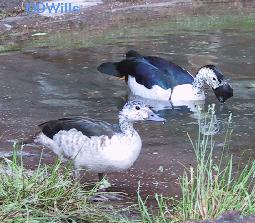
the Discovery Island trails are small ponds, with colorful birds.
The African Comb Duck, native to Africa, Asia and South America
will travel as much as 2,200 miles when migrating.
Their
backs are dark with violet, bronze, purple and green coloring. They nest
in hallow trees often near marshes or lagoons. They are tropical and considered
peaceful ducks.
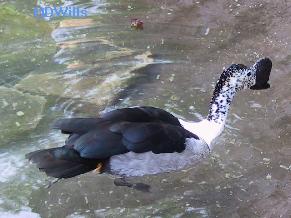
The
males have a fleshy knob at the base of the bill, which increases in size
during breeding season. The females do not have the "comb" and
are smaller. The Comb Duck scientific name (Sarkidiornis melanotos)
originates from the Greek, and loosely translates to a black-backed bird
with a fleshy knob.
The
African Comb Duck has been honored on at least 10 Africa Postage stamps.
|